ESCAPED LUNATIC - or was he?
 |
| NSW Police Gazette, 4 March 1885. p. 68 [1] |
Escaped from the Hospital for the Insane, Gladesville, on the 22nd ultimo, William Fryer, 68 years of age, clean shaved, with white hair; dressed in a dark frock cloth coat, black trousers and dark felt hat. A resident of Shellharbour, and a Justice of the Peace. NSW Police Gazette, 4 March 1885 [1]
NOTE: Much of this story is told from reports in newspapers in the 1880's and 1890's. The sources the newspapers used were letters written by William Fryer and his son Humphrey Fryer, court records and testimonies given in court, as well as pleas for help for William Fryer in the NSW Legislative Assembly by a Member of Parliament, Mr. Abigail.
The background to this story was researched using genealogical resources. Since William Fryer was declared to be sane by two reputable doctors in 1885 [2] I feel this story of an apparent injustice needs to be told.
INTRODUCTION
The fascinating but disturbing story of how of William Fryer was detained for some years in the Gladesville Lunatic Asylum by at least four of his sons, and his subsequent battle for a fair hearing, came to light through newspaper articles on Trove. Although I cannot travel backwards in time to understand the actual situation that occurred within the family, the story appears by all accounts, to have been a travesty of injustice.
The fascinating but disturbing story of how of William Fryer was detained for some years in the Gladesville Lunatic Asylum by at least four of his sons, and his subsequent battle for a fair hearing, came to light through newspaper articles on Trove. Although I cannot travel backwards in time to understand the actual situation that occurred within the family, the story appears by all accounts, to have been a travesty of injustice.
 |
| William Fryer, 5th from left, 1870 Image Shellharbour Council Archive |
WILLIAM FRYER [1816-1890]
William Fryer was baptised on September 22, 1816 in Maidstone, Kent, England [3]. He was the son of an agricultural labourer George Fryer and his wife Ann Harris [4] and he came from a large family. By the age of nineteen, William was working as a brickmaker [5]. This fact is known only because at that age William had a serious encounter with the law and his occupation was stated on his convict indent as well as other records relating to his transportation to NSW on August 4, 1836, on board the Benghal Merchant.[6]
 |
| The Burglary at Mr Hunt's [7] |
NOTE: The crime committed by William Fryer in Maidstone, Kent, England, and the unusual circumstances of the apprehension of himself and his friends, deserves a blog post of its own, so watch for the soon to come blogs entitled, "The Robbery at Mr Hunt's" and "The Hat that Caught the Thieves" . Both will be published on my convict blog Convict Convictions - A Convict Ancestor.
Also watch out for Part 2 of this story "What the Archive Records Revealed" which will be published on this blog.
 |
| Convict Gang, Image Wikimedia under Creative Commons Licence. |
William Fryer was charged with burglary in the Kent Assizes in March 1836 [8] and was sentenced to death along with three other young men accused of being involved in the crime. Fortunately for William, his sentence was commuted to Transportation for Seven Years to New South Wales and his life was saved.[8]
This blog is not however, about William Fryer's crime nor his convict life, but rather it concerns a series of troubling events which occurred many years after he had settled in the Kiama and Albion Park area on the southern coast of New South Wales - in fact, it was almost twenty years after he became a family man, well respected in his local and surrounding community as a JP (Magistrate), a councillor and the first Mayor of Shellharbour Council [9] (a position he held for five years).
 |
| William Fryer and Sophia (Dunster) Image obtained from Shellharbour Council Archive |
THE STORY UNCOVERED IN NEWSPAPERS
The story I discovered which tells of William Fryer being detained in Gladesville Mental Asylum, began many years after he arrived in NSW as a convict charged with burglary. By 1877, William had married and produced a large family. One of his sons was a Clergyman in the Church of England and several were, like he himself, members of Local Government. By all acounts this man, once a convicted thief, had led an exemplary and purposeful life on the South Coast region of NSW.
I will begin the first chapter of this strange tale a few years preceding the day in March of 1882, when incredulously and in the most horrendous circumstances, three of William Fryer's older sons, reportedly conspired to have him 'kidnapped' while on a business trip to Wollongong [10], transported to Sydney by steamer and then detained in a mental asylum. The events which transpired, did so seemingly to take ownership of the property belonging to William Fryer at Mount Terry, Albion Park, NSW. [11] The unfortunate story of a family dispute unfolded in a most public manner in the newspapers.
 |
| William Fryer's land was mentioned in an advertisement for land sales 1860 [11] |
William Fryer's tragic circumstances and his three year long battle for a medical examination and to declare himself sane, was published in both local and Sydney newspapers. His case travelled as far as the NSW Legislative Assembly (Parliament) where it was stated when outlining William Fryer's particular case, that there had been instances in which people desiring to get rid of inconveniences standing between them and property had paid money for certificates on which to continue their friends in asylums and so get access to their wealth.[12]
THE CASE OF MR WILLIAM FRYER OF ALBION PARK, JP [12]
 |
| Illawarra Mercury 30 September 1884, p. 2. [12] |
In the Assembly, on Tuesday, Mr Abigail....referred to several of these cases occurring in Victoria and New South Wales, to show that it was quite possible for a sane man to be illegally placed in a lunatic asylum, and that such things were really done. The case he was about to refer to [sic William Fryer] demanded serious consideration and investigation. [12]
 |
| William Fryer's case being heard in the NSW Assembly September1884 [12] |
I had no suspicion of my own sons doing me a wrong, but before I knew it, we arrived at Gladesville Asylum, in which place my sons lodged me, for what I do not know....William Fryer, 1884 [12]
It appears from events reported in various newspapers that a number of William Fryer's sons and (according to William Fryer himself [13 ] ), the family of his first wife, were unhappy when William remarried after being widowed.
William Fryer had married Sophia Dunster, the daughter of a free settler, in 1843 'by consent of the governor' [14] . He had obtained a Ticket of Leave [15 ] the previous year, permitting him to work in the Illawarra region. Sophia, eight years William's junior, was from Stone In Oxney, Kent, not far from Maidstone [16] where William's family lived. The Dunsters arrived in Australia as free immigrants in 1838 [17] and settled in the Illawarra area of New South Wales, where Joseph Dunster and his sons earned a prominent standing in the Illawarra community.
 |
| The Marriage of William Fryer to Mary Norris nee Whittaker [21] |
Sophia Fryer died in May of 1876 [18] leaving behind a large family. Her surviving seven sons and three daughters ranged in age from 33 to the youngest, who was 10 years of age [19].
On the occasion of William Fryer's marriage to the widow Mary Norris, nee Whittaker, 18 months after the death of his first wife, on November 3 1877 [20], at his property at Albion Park, a riot occurred disrupting the occasion. From this incident and reports of the same, in the Illawarra Mercury [21], it may be deduced that certain people were unhappy with the union between William Fryer and Mary Norris.
The following news item - the report of a police court hearing - reveals that that the marriage was disrupted by evil disposed persons engaged in discharging firearms and throwing stones on the premises [22].
 |
| A disturbance occrred during the wedding of William Fryer and Mary Norris [22] |
Mr Roberts, of Sydney, who appeared for the defendants, ... noted that the defendants had acted foolishly and apologised for them, saying that they expressed regret for what had occurred and promised not to interfere with Mr Fryer again [22].
One can easily see how William Fryer, might have upset his family dynamics when, with ten living offspring of his own, he married the widow Norris, a mother of eleven children, nine of whom were still in her care [23].
If William's family had concerns over inheritance then another child, a son born to William Fryer and Mary Norris in December 1879 [24], may have been the catalyst which set in motion the terrible events which occurred in William Fryer's life between March 1882 until June 1885. Edward Ernest Percy Fryer was an 11th living child for William and 12th for his wife Mary.
William Fryer's case first came to light publicly in September 1884 [25] two and a half years after it was stated that he had been placed by his sons in the Gladesville Mental Asylum. Mr Abigail, a member of the New South Wales Legislative Assembly called to the attention of the House (of Parliament) a matter of such urgency regarding misappropriation of the Lunacy Act, that the case he is about to refer to deserves consideration and investigation.
He [sic Mr Abigail] produced a letter addressed to him by the individual concerned in this matter, who had been kept in Gladesville for two year, and was still detained there, regardless of his demands for an investigation. [26]
If William's family had concerns over inheritance then another child, a son born to William Fryer and Mary Norris in December 1879 [24], may have been the catalyst which set in motion the terrible events which occurred in William Fryer's life between March 1882 until June 1885. Edward Ernest Percy Fryer was an 11th living child for William and 12th for his wife Mary.
William Fryer's case first came to light publicly in September 1884 [25] two and a half years after it was stated that he had been placed by his sons in the Gladesville Mental Asylum. Mr Abigail, a member of the New South Wales Legislative Assembly called to the attention of the House (of Parliament) a matter of such urgency regarding misappropriation of the Lunacy Act, that the case he is about to refer to deserves consideration and investigation.
He [sic Mr Abigail] produced a letter addressed to him by the individual concerned in this matter, who had been kept in Gladesville for two year, and was still detained there, regardless of his demands for an investigation. [26]
 |
| Latest Parliamentary News, 27 September 1884 [27] |
William Fryer's letter to Mr Abigail [28] was not his first correspondence in an attempt to be freed from the asylum where his sons had placed him, but this was the letter which was reproduced in newspapers from the south to the north coast of NSW and in Sydney.
This letter describes the manner in which William Fryer's sons plotted for him to be forcibly captured in order to be taken to Sydney and then to Gladesville Asylum from his hotel lodgings in Wollongong. [28]
 |
| Letter, Image PXhere |
On the second Monday of March 1882, I left my house to go to Wollongong on business.... When we arrived in Wollongong I then went to my hotel and had tea. After tea I engaged a room for two or three days, as I had important business to see to. I then went to a lecture, which was held that evening in the Wesleyan Church, by the Rev John Osborne, for the benefit of the building fund. After the lecture I subscribed 1 pound towards the fund [ ...] went to bed. Next morning, after breakfast was over, I went to the bank and did my business there ....
At dusk I returned to my hotel, had tea, and went into my bedroom to read. At half past 7 o'clock, whilst I was still engaged in reading, a knock came to the room door. I got up to open it and as soon as I had done so in rushed a lot of ruffians who caught hold of me and began dragging me from one side of the room to the other in a most unfeeling manner.
I called for the proprietor of the hotel to come and rescue me out of their hands; he did so.
After a while I sat down to read again. I had not been reading more than 10 minutes when the mob came again and broke into my room. There appeared to be more of them than when they came the first time. They used me in a brutal manner; they tore my clothes off my back, and cut and hacked my face and hands; they then dragged me down two flights of stairs into the hall below; they then left me and cleared away.
As soon as I recovered myself I went to look for the police but could not find any of them. On my way along the street I met the Mayor of Wollongong. I remonstrated with him about what had happened to me and I asked him to protect me from further injury. He said he was sorry for me, but that as he was going by the steamer to Sydney he could not stop, as the steamer's bell had just rung for the passengers to board. He advised me to seek police protection.
I then went to Mr. McDonald's boot and shoe mart. They would have protected me, but the mob surrounded the house, led on by the Rev. John Osborne. Mr McDonald urged of them to stop there, but Mr Osborne said it was no use - out I must come.
So the mob tore me out of the house. Mr. Osborne remained at McDonald's speaking to them. I was dragged by the mob along the street until they brought me to Mr. Hoskin's chemist shop, where they had a buggy waiting for me. They threw me into it by main force, and in my struggle to get free I was thrown out of the buggy on the other side of it on to the hard road, and in attempting to gain my feet again I caught hold of Mr. Hoskin's coat. He tried to get free from me, and in attempting to do so the coat was torn off his back in two pieces.
By this time I was bleeding from face and hands, and my clothes were saturated with blood. I was again thrown into the buggy and driven down to the wharf and put on board the steamer for Sydney. It was so dark that I could not tell who was there or how many, but at Mr. Hoskin's shop I saw five or six that I know and can swear to them.
Next morning, after the steamer had arrived in Sydney, I was taken to Dobson's board and lodging house in Phillip Street. My eldest son [sic Joseph] was with me then, and we stopped at Dobson's from Tuesday to Friday, when two of my younger sons (William and Henry) came. My eldest son left me with them.
After breakfast on Friday we went out to do some shopping ... my son William said to me to not walk too far, but to get a cab. The cab was hired, my two sons and I getting into it. William said he would go to Mrs Judson's in Newtown, as he had business there.
I took no notice of his saying so, as I knew that they were acquainted. I took no notice of the direction we were driving, as I had no suspicion of my own sons doing me a wrong, but before I knew it, we arrived at Gladesville Asylum, in which place my sons lodged me, for what I do not know.
Mr Abigail went on to tell the members of the Assembly that Mr. Fryer was still in the Asylum and that there could be no doubt that if he were examined by independent medical men that he would be pronounced perfectly sane. Mr. Abigail had been spoken to by residents of Ryde, to whom Mr. Fryer was well known, and they told him that it was a scandal to keep a man like that in the asylum. [28]
William Fryer claimed in his letter that while he was an inmate of the Gladesville Mental Asylum, he was permitted to go out into Sydney city unaccompanied, and that on several occasions he had made his way to the Illawarra district but that he did not stay away for long for fear he would be arrested. [28]
On one such occasion, in early 1885, when permitted some freedom, William Fryer decided to finally make his escape from Gladesville Asylum. He travelled to Wollongong where he conducted the business of placing his property (Buckley's Field, situated at Mount Terry) for sale. An advertisement for the sale of his "Splendid Farm" appeared in the Illawarra Mercury on 4 June 1885.[29]
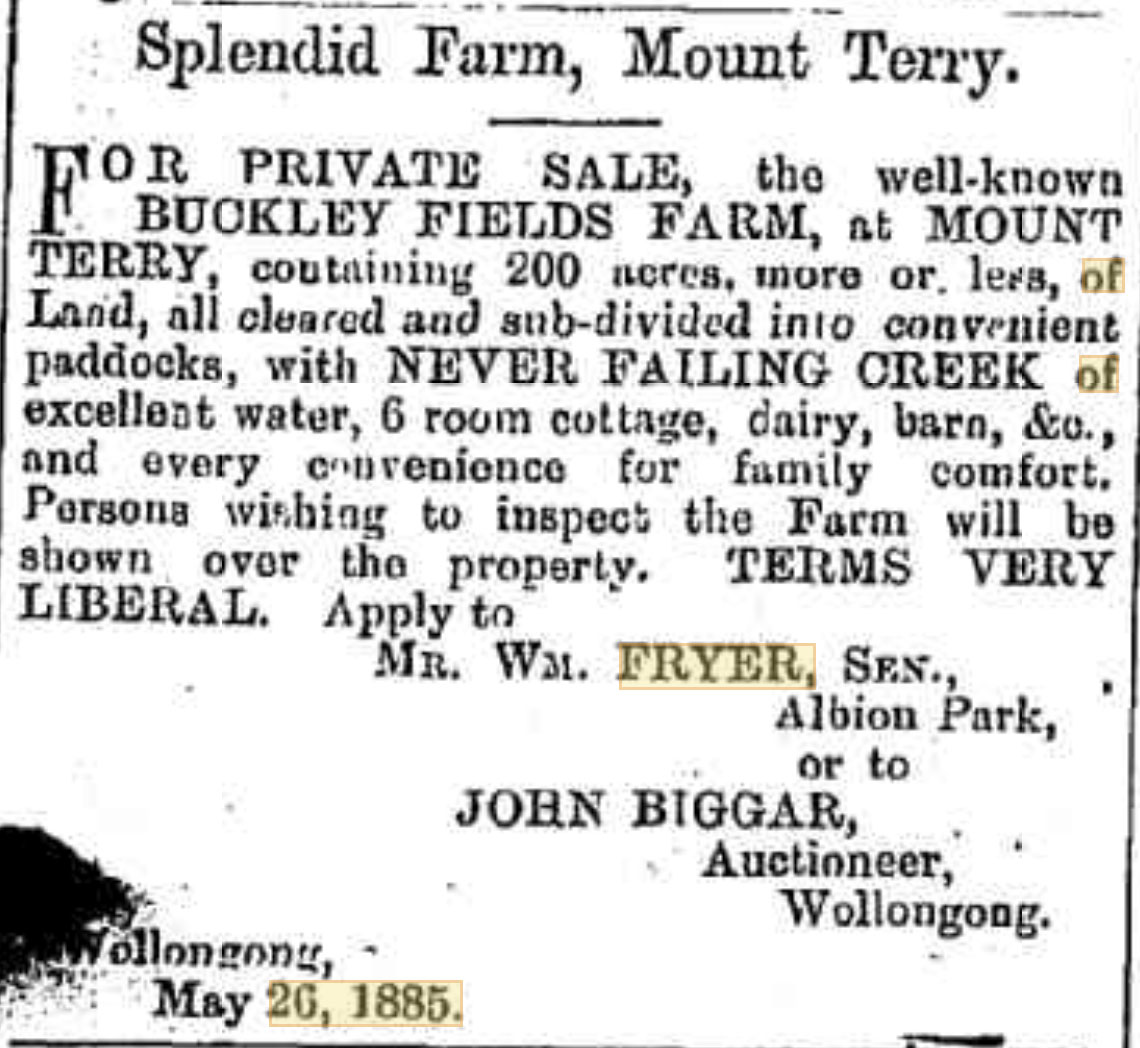 |
| William Fryer's advertisement for the sale of his land at Mt Terry [29] |
It appears obvious that William's family had become aware of his freedom and they placed their own advertisement [30] which was a caution against the sale of the property. It appeared on the very same page of the 4 June edition of the Illawarra Mercury as William Fryer's advertisement. The family dispute was now playing out in a most public manner as William's sons attempted to prevent him from selling his own property. These advertisements, one advertising the property Buckley's Field for sale and the other cautioning against it, appeared side by side in the Illawarra Mercury, weekly, throughout June and July of 1885.
 |
| Caution against William Fryer's attempt to sell his land [31] |
William Fryer's son Rev. Humphrey Fryer, in an attempt to return his father to the asylum, and prevent the property sale, applied for a warrant for his arrest. [32]
 |
| Advertisement in March 1885 in the Illawarra Mercury [33] |
When William Fryer was arrested in June 1885, in Wollongong by Constable Saunders, his comment to the police officer was, It is very hard that I may be persecuted like this.[33] He reportedly however, went with the officer quietly [33] . After two years of attempting to plead that he was in his right mind, and finally escaping the Gladesville Mental Asylum, William Fryer, former Mayor of Shellharbour Council, was arrested at Mrs McRae's boarding house in the parlour in Wollongong and detained by police, at the bidding of his son Humphrey. William Fryer appeared before the Court of Petty Sessions on Wollongong on 2 July 1885.
William Fryer, sen.. appeared in custody, having been apprehended at the instance of his son, the Rev. Humphrey Fryer, who laid the following information before the Police Magistrate - 'That William Fryer, sen, Contrary., a person deemed to be insane, is wandering at large at Wollongong, and has been discovered by this informant that denote that the said William Fryer, sen., has a purpose of committing some offence against the law, Contrary to the Act, in such case manic and provided.'[33]
 |
| Report in the Illawarra Mercury of William Fryer sen.'s appearance in the Court of Petty Sessions [33] |
Humphrey Fryer confirmed in court that he had requested his father's arrest and offered the following reasoning for his action - I think from what my father said to me on the occasions I have referred to [sic on three occasions he saw him away from the asylum] that he means some harm to Dr. Tarrant [sic a doctor who William Fryer claimed assisted his sons in having him detained] and the Dunsters, [sic his first wife's family whom he believed to be behind his placement in the asylum] and that he is endeavouring to dispose of his property in some way, which I believe he would not do if he was in his right mind.[34]
There in Humphrey's statement regarding the disposal of property, lies the probable cause of William Fryer's troubles. It can be reasonably deduced from reading the testimonies and letters of both Humphrey and his father William Fryer [35] that the actions taken to place the latter in Gladesville Mental Asylum were for the most part, to prevent the sale of William's 200 acre property, Buckley's Field at Mount Terry.
 |
| Gladesville Mental Hospital Image Wikipedia. |
Leading up to William Fryer's arrest and appearance in the Court of Petty Sessions he had been placing weekly advertisements in the Illawarra Mercury for the sale of his property Buckley's Field. His son Henry claimed to be in possession of the property by a lease agreement. [38] William stated that my property during my detainment has brought forth to rent about 2000 pounds, and where it has gone I do not know - instead of it going to make my life comfortable it has been partly used to my detriment. [39]
In July 1885, three years after William Fryer's sons had placed him in Gladesville Mental Asylum, the Court of Petty Sessions in Wollongong, finally ordered two independent doctors, Dr Lee and Dr Sturt, [37] to examine him and to ascertain his degree of sanity.
Dr Lee declared that If I were to give a certificate it would be sanity. [38] and Dr Sturt said, Perfectly sane, and surprised at being called to examine Mr. Fryer. [38]
William Fryer was finally a free man, and as such he continued, unopposed (publicly at any rate), to run weekly advertisements in the Illawarra Mercury from July until December 1885 in an attempt to sell his property Buckley Fields.
 |
| William Fryer is finally ordered to be medically examined by the Court [37] |
Despite Humphrey Fryer's public defence of his and his brother's actions in placing and detaining their father in Gladesville Mental Asylum, in a letter (below) to the Illawarra Mercury, 4 July 1885, William Fryer had the seemingly last public say, in a letter to the Editor of the Illawarra Mercury published 11 July 1885, in which he scathingly berated his son Humphrey. [38]
 |
| Introduction to Rev. Humphrey Fryer's Letter to the Illawarra Mercury 9 July 1885.[37] |
... from first to last, his very action has been anything but that of a good son (though he ought to have been the very best one), to have behaved in the manner he has done, when it is remembered that he is a clergyman of the good old Church of England... Willliam Fryer [38]
 |
| William Fryer's Letter to the Editor 11 July 1885 [38] |
William Fryer had spent three and a half distressing years detained by his sons in Gladesville Mental Hospital, despite his public pleas to save me from that horrible place.[36] After he was finally declared sane and freed, William Fryer claimed I may inform the public that all the time I had been detained in the asylum in Gladesville, I was never yet charges with insanity, but that I could not agree with my family. [38]
The property at Mount Terry did not sell, and was finally advertised as available for a three year lease on January 15 1886 [39].
 |
| William Fryer's property advertised To Let 1886. |
William Fryer died on the 9th of August of 1890 at Albion Park on the NSW South Coast. His obituary, published in the Illawarra Mercury mentions his first wife and the sons and daughters from his first marriage. The glowing account of his life in his obituary in the Illawarra Mercury 12 August 1890,[41] boasts highly of William Fryer's accomplishments, in local government as the first Mayor of Shellharbour Council, and as the husband of Sophia Dunster. There was no mention of the three and a half terrible years William spent in the Gladesville Mental Hospital, or his fight to prove his sanity and to regain control of his property.
 |
| William Fryer's Obituary [41] |
 |
| Mention of William Fryer's second wife and son Percy.[42] |
I cannot help but wonder what horrors William had to endure in the Gladesville Mental Hospital, but at the same time, I am pleased that William was able to prove the truth of his situation in the end.
The truth is rarely pure and never simple... Oscar Wilde
PART TWO IS YET TO COME
Records from the NSW State Archives hold many of the Gladesville Mental Hospital Records hold more of the story of this episode in William Fryer's life.
FOOTNOTES
1. Trove, NSW Police Gazette, Escaped Lunatic, 4 March 1885. p. 68.
2. Trove, Illawarra Mercury, The Case of Mr William Fryer J.P. of Albion Park, 30 September 1884, p. 2.
2. Trove, Illawarra Mercury, The Case of Mr William Fryer J.P. of Albion Park, 30 September 1884, p. 2.
3. Ancestry.com, Baptism William Fryer, England, Select Births and Christenings, 1538-1975 [database on-line]. Provo, UT, USA: Ancestry.com Operations, Inc., 2014, Original data: England, Births and Christenings, 1538- 1975. Salt Lake City, Utah: FamilySearch, 2013.
4. Ibid.
5. Ancestry.com, NSW Convict Indents, 1788-1842, Convict Indent for William Fryer, 1836.
6. Ibid.
7. The British Newspaper Archive, Maidstone Gazette and Kentish Gazette,The Burglary at Mr Hunt's, 21 March 1836, p. 3.
8 .The British newspaper Archive, Kentish Gazette, Prisoners, 21 October 1834, p. 3.
9. Trove, NSW Government Gazette, Magistrates Appointed, 4 October 1876, p. 303.
10. Trove, Illawarra Mercury, The Case of Mr William Fryer J.P. of Albion Park, 30 September 1884, p. 2.
10. Trove, Illawarra Mercury, The Case of Mr William Fryer J.P. of Albion Park, 30 September 1884, p. 2.
11. Trove, Examiner, Forty Eight Splendid Farms, 23 May 1860, p. 2.
12.Trove, The Illawarra Mercury, The Case of Mr William Fryer, JP, 30 September 1884, p. 2.
13. Ibid.
14. Ancestry.com, NSW, Australia, Registers of Convicts Applications to Marry, 1826-1851, NSW State Archives, Series 12212.
15, Trove, NSW Government Gazette, 23 February 1842, p. 2.
16. Trove, Illawarra Mercury, Court of Petty Sessions, 4 July 1885, p. 2.
16. Ancestry.com, Baptism Record of Sophia Dunster, England Select Births and Christenings, 1538-1975
14. Ancestry.com, NSW, Australia, Registers of Convicts Applications to Marry, 1826-1851, NSW State Archives, Series 12212.
15, Trove, NSW Government Gazette, 23 February 1842, p. 2.
16. Trove, Illawarra Mercury, Court of Petty Sessions, 4 July 1885, p. 2.
16. Ancestry.com, Baptism Record of Sophia Dunster, England Select Births and Christenings, 1538-1975
17. Ancestry.com, State records NSW, Kingswood NSW, Entitlement Certificates of persons on Bounty Ships, Series 5314, Reel 1291.
18. NSW Government Registry of Births, Deaths, and Marriages, Death Certificate of Sophia Fryer, 28 May 1876, Registration Number 6958/1876.
19. NSW Government Registry of Births, Deaths and Marriages, Births of Children of William Fryer and Sophia Dunster.
20. NSW Government Registry of Births, Deaths and Marriages, Marriage of William Fryer and Mary Norris, 4800/1877.
21.Trove, The Kiama Independent and Shoalhaven Advertiser, Marriage, 9 November 1877, p. 2.
21.Trove, The Kiama Independent and Shoalhaven Advertiser, Marriage, 9 November 1877, p. 2.
22. Trove,The Illawarra Mercury, Kiama Police Court, 27 November 1878, p. 2.
23. NSW Government Registry of Births, Deaths and Marriage, Births of Children of William Henry Norris and Mary Whittaker.
24.NSW Government Registry of Births, Deaths, and Marriages, Birth of Edward Ernest Percy Fryer, 16764/1879.
25. Trove, Illwarra Mercury, The Case of Mr William Fryer J.P. of Albion Park, 30 September 1884, p. 2.23. NSW Government Registry of Births, Deaths and Marriage, Births of Children of William Henry Norris and Mary Whittaker.
24.NSW Government Registry of Births, Deaths, and Marriages, Birth of Edward Ernest Percy Fryer, 16764/1879.
26. Ibid
27. Trove, Maitland Mercury and Hunter River Adviser, Latest Perliamentary News, 27 September 1884, p. 4.
28. Trove, The Illawarra Mercury, The Case of Mr William Fryer, JP, 30 September 1884, p. 2.29. Trove, Illawarra Mercury, Splendid Farm, Mount Terry, 4 June 1885, p. 3.
30. Trove, Illawarra Mercury, CAUTION, 4 June 1885, p. 3.
29. Trove, NSW Police Gazette, Escaped Lunatic, 4 March 1885. p. 68.
30. Trove, Ilawarra Mercury, Court of Petty Sesssions, 4 July 1885, p. 2.
31. Ibid.
32. Trove, Illawarra Mercury, Original Correspondence, Letter from Humphrey Fryer, 9 July 1885, p. 2.
33. Trove, Ilawarra Mercury, Court of Petty Sesssions, 4 July 1885, p. 2.
34. Trove, Illawarra Mercury, Original Correspondence, Letter from Humphrey Fryer, 9 July 1885, p. 2.
35. Trove, Illawarra Mercury, Original Correspondence, letter from William Fryer, 11 July 1885, p. 2.
36. Trove, Illawarra Mercury, Court of Petty Sessions, 7 July 1885, p. 2.
37. Trove, Illawarra Mercury, Original Correspondence, Letter from Humphrey Fryer, 9 July 1885, p. 2.
38. Trove, Illawarra Mercury, Original Correspondence, letter from William Fryer, 11 July 1885, p. 2.
39. Trove, Illawarra Mercury, To Let, 15 January 1886, p. 3.
40. Trove, Ilawarra Mercury, Court of Petty Sessions, 4 July 1885, p. 2.
41. Trove, Illawarra Mercury, Obituary of William Fryer, 12 August 1890, p. 2.
42. Trove, Illawarra Mercury, The Late Mr William Fryer, Albion Park, 26 August 1890, p. 2.


