Friday, August 22, 2014

Genealogy Photo Challenge 2014

Genealogy Photo Challenge 2014 for World Photo Day 


The Family Curator has issued a challenge to genealogists and family historians around the world to celebrate World Photo Day by creating a photograph which blends pictures of the past and the present in a single photo. Thankyou to Pauleen  for her Genealogy Photo Challenge blog post which reminded me to delve through my photographs to find something suitable for this challenge. 


Houses, like all buildings, are constantly altered and adapted over time, for families and their changing needs and purposes. Every home is the heart of the family and as such is the keeper of memories. As a home changes and people move in and out of it, the house becomes an archive of collective memory. I am pleased to take this opportunity to tell just a snippet of this home's narrative.


My first home was at 24 Crescent Avenue in Enoggera, a suburb of Brisbane, Queensland in Australia. My parents built a brand new house in a newer suburb when I was seven years old but the home at Enoggera has always remained significant as the source of my earliest important childhood memories.


 While on holidays in Queensland, several  trips down memory lane, have found me driving past my first family home. Over the years since I lived in the house, it has undergone some significant alterations.


1950's

The home pictured above, was built in the 1950's, as a two bedroom weatherboard house with a brick base at the front but was higher at the rear with timber slats, in typical Queensland style. Shown in the photo below (and above in the 2000 and 2014 photographs) are the cassia trees which my mother planted along the side boundary fence. Now, in late 2014, these trees have been removed.

Rear of the house 1960's

During the seven years during the 1950's and 1960's when I lived in the home at Enoggera, it was painted a pale grey/green colour. It had a balcony with an ornate wrought iron railing and wide brick stairs at the front of the house. 


The balcony at the front of the house ©


The fence was made of wire and white timber with white metal gates. Image Sharn White ©


2000

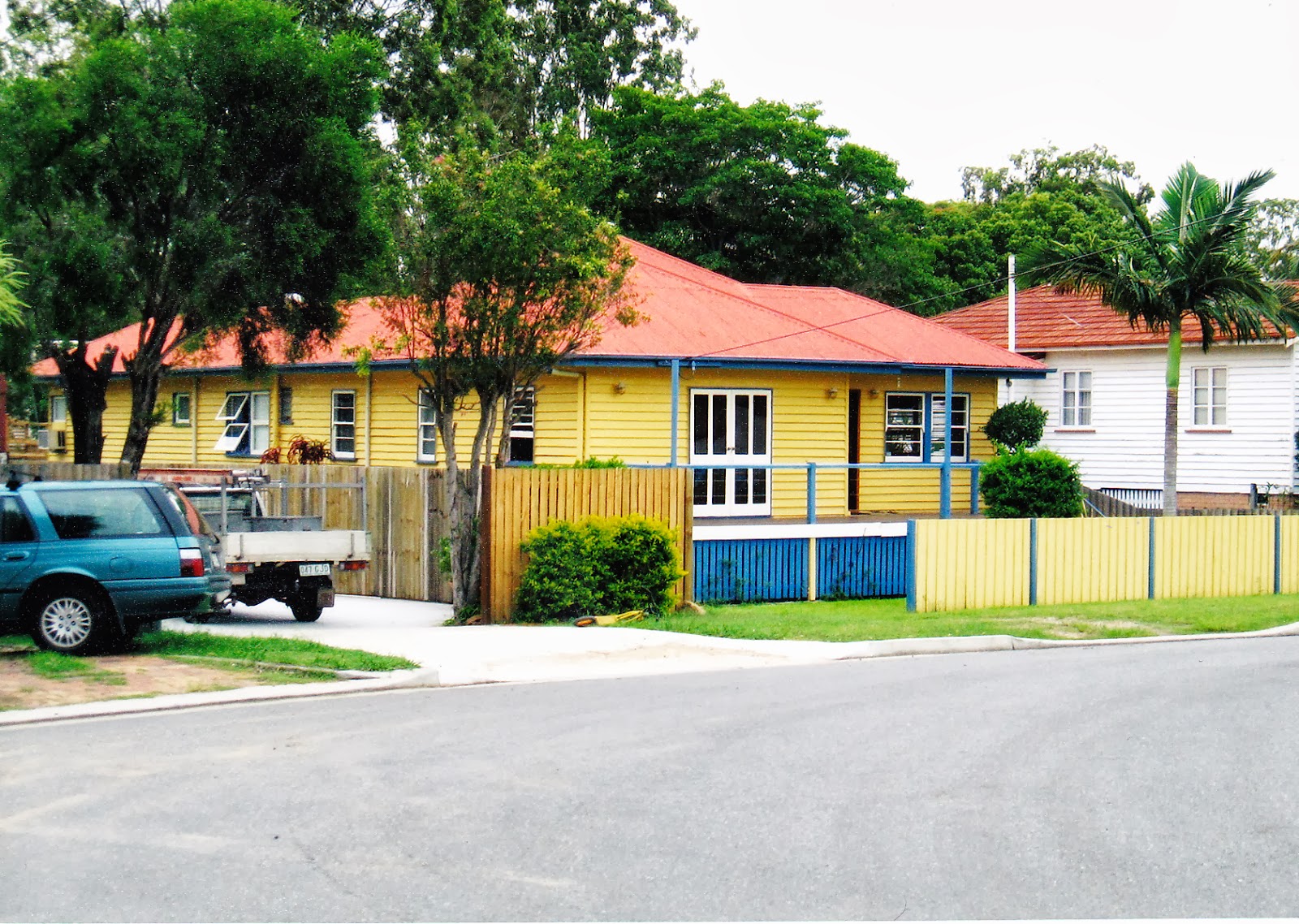
In 2000, when I saw my first home, I was surprised to see that it had changed considerably from the time when I had lived in it as a young child. New owners had modernised the house, enlarging it and replacing the brick balcony with a timber deck at the front. The window to the living room was the very same window however, as when I had lived there decades earlier. I recall climbing upon our lounge to watch through that window for the ice cream van. The colour scheme was vastly different with its bright yellow weatherboards and blue trimmed windows. What had seemed to me as a young child to be an enormous backyard had been reduced in size by a new extension to the rear of the house. 

My first home in 2000 Image SharnWhite 

2014

The latest view of my first home made me wonder if I had driven along the wrong street! It wasn't just that the colour scheme had altered but the roof line had changed significantly and the house bore little resemblance to the one I had lived in. It was only the brick base that was still recognizable from the past. The roof which had been a hip roof now looked very different with new gables. The 1950's built house had gone full circle and even back in history with its new transformation,  giving it the appearance of a  home reminiscent of the 1920's. 


Wednesday, August 13, 2014

Knocking down Northern Irish Brick Walls using Wills.

"In the name of God, Amen, I William White of Brookend, Arboe... declare this to be my last Will and Testimony" and... Who was Sarah Jane Thompson?

Jemima Florence White -  daughter of Sarah Jane Thompson and Hugh Eston WHite,  grand daughter of William White and great grand daughter of Samuel Clarke  


BREAKING NEWS: Not one, but two seemingly impenetrable Northern Irish Brick walls have recently crumbled through the finding of Wills of ancestors.

As anyone with Irish or Northern Irish ancestry will attest, the journey towards finding Irish and Northern Irish ancestors has long been fraught with difficulty. Despite websites such as Emerald Ancestors, Ancestry Ireland, FindmyPast Ireland, The Ulster Foundation, and Irish Origins, just to name a few, my Northern Irish ancestry was not easy to trace until I recently found the Wills of Northern Irish ancestors.  PRONI, the Public Record Office of Northern Ireland must be congratulated for its project to digitalise Will Calendars. The records attached to the website's facility for searching Will Calendars were updated in March 2014, to cover the period 1858-1965. Will transcripts have been digitalised and images are currently available for Londonderry 1858-1899, Belfast 1858-1909, and Armagh 1858-1918. If you haven't visited the PRONI website for a while, it may be well worthwhile conducting a new search.

The discovery of the Last Will and Testimony of my great great grandfather, William White of Brookend, County Tyrone and also the Will of my three times great Grandfather Samuel Clarke of Ballycomlargy in County Londonderry, threw wide open, a window to my Northern Irish ancestry. Samuel Clarke's Will was kindly sent me to me by a previously unknown Irish cousin who found me through Ancestry.com. It is now available for me to download on the Proni website as well. I have also recently found the Will of my great great grandfather, William White on the PRONI website. Prior to reading the contents of these Wills, I knew frustratingly little about my County Tyrone and Londonderry ancestors.
Hugh Eston White, son of William White of Brookend and Sarah Jane (Thompson) grand daughter of Samuel Clarke of Ballycomlargy

                WHAT INFORMATION MIGHT BE FOUND IN A WILL

Wills are an invaluable resource for family historians. Depending on the detail included in your ancestor's Will, you may find singularly exclusive information concerning such assets as land, farms, businesses and homes owned by ancestors. Will Calendars inform you of the date of death of an ancestor as well as when Probate was proved. Wills also disclose which family member inherited the family property. This is especially meaningful information if you are interested in a history of the land or house. Wills also importantly detail where an ancestor lived. In the writing of a Will, one of my Northern Irish ancestors helpfully provided a most detailed description of the location of his farm in Ballyblagh, Omagh. He named the roads between which it lay, the river which ran through it, its acreage, a description of the house and farm buildings, and even the number of cows he owned. This is particularly useful data since I am researching from Australia and therefore unable to search the land registry in Belfast in person.

Wills often include the occupations of ancestors and the employment of other family members. Other particulars of interest which may be listed are family possessions. These may range from details of farm equipment, household items and furniture to  personal items such as jewelry. If you have any precious family heirlooms in your family, it just might be that an ancestor's Will could provide the clue to tracing its origin. I have established the provenance of a family eternity ring through its mention in three generations of Northern Irish Wills. If you are fortunate enough to have had a particularly loquacious ancestor, his or her Will might make mention of  such personal items as a family bible, books, a piano, special items of furniture, or every day things including beds, bedding and even brushes and combs! Wills can provide much or meager information, depending upon the writer. I have found progenitors' Wills which are so devoid of detail as to straightforwardly  'leave all my belongings to my wife', and others which are an indubitable bounty of information.

Wills often include the names of spouses and children and often, significantly, married names of daughters. Frequently the writer of a Will names grandchildren and other relatives or family friends. Depending upon the amount of information a person has chosen to include in his or her Will, it may disclose places of residence of relatives and the names of their spouses. Sometimes a Will is a veritable wealth of information you would not find anywhere else. One example of information likely to be found only in a Will, are the names of  children born outside a marriage.  I have one Northern Irish ancestor  who kindly included the name of his 'illegitimate' son in his Will, thereby informing me of a previously unknown branch of family to trace. It is doubly rewarding to discover that an ancestor of the wandering kind was charitable enough to provide in his Will for offspring of a liaison. Not only do you learn that he was a fairly decent chap, but importantly, he has divulged to you a possibly well kept  a family secret.

A wonderfully wordy Will might furnish you with crucial clues regarding the whereabouts of  other descendants of your ancestors. When family members immigrated to different countries, they frequently lost contact over several generations. As a consequence, later generations may have no knowledge of their whereabouts. Much research time can be saved if your ancestor benevolently imparts this information in a Will. In my great great grandfather William White's last testament, he generously bequeathed me much valuable information regarding  the countries, cities, towns and addresses to which each of his offspring had immigrated, as well as affirming the addresses of several daughters who had remained in Northern Ireland.

It is important to note that there can also be misleading omissions in Wills. For varying reasons,  the name of one or more offspring might be absent, as was the case in the Last Will and Testament of  my three times great grandfather, Samuel Clarke. The absence of a crucial name in his Will generated a perplexing mystery for the Irish branch of my Clarke family, although it was this very omission which eventually  brought two branches of our family together.


THE WILL OF SAMUEL CLARKE OF BALLYCOMLARGY, COUNTY DERRY, FARMER - AND WHO WAS SARAH JANE THOMPSON?


The Last Will and Testimony of my three times great grandfather, Samuel Clarke, was discovered not by myself, but by someone in Ireland who I now know to be my third cousin. We both descend from Samuel Clarke, (1808-1889), a farmer of  Ballycomlargy, Londonderry, in Northern Ireland. My cousin found me while attempting to solve a family mystery. Samuel Clarke's Will had named a granddaughter, Sarah Jane Thompson, but inexplicably, had made no mention of who her parents were. Although Samuel named his children in his will, he had no daughters with the married name of Thompson and none of his children had a daughter named Sarah Jane. Sarah Jane Thompson, although stated in the Will to be Samuel's granddaughter, did not appear to fit into the Clarke family anywhere and her identity remained a mystery to the family in Ireland until the search led to my Ancestry Tree.

Sarah Jane Thompson sits elegantly on a paternal branch of my family tree, as my great grandmother, Sarah Jane White, nee Thompson. Sarah Jane immigrated to Brisbane, Queensland, Australia in 1912 with her husband, my great grandfather, Hugh Eston White and their five children, one of whom was my grandmother Jemima Florence White. Sarah Jane Thompson's mother was the only offspring of Samuel Clarke not  named in his Will.

Contact between my cousin and I through Ancestry.com generated an exciting exchange of information which connected two branches of a family who lived on opposite sides of the world, each who had no previous knowledge of the other. There was a reason why Samuel Clarke's daughter was not mentioned in his Will but his granddaughter was named.


Samuel Clarke wrote his will in 1887. His daughter Sarah Jane Clarke, the eldest of his eight children, had predeceased her father, in 1873, at the age of 40 years. In his Last Will and Testimony Samuel Clarke mentioned only the names of his living offspring. He made provisions for one child of his deceased daughter because he himself had raised her. Sarah Jane Thompson's four older siblings had remained with their father, who remarried the same year that their mother died. Years later, with older generations of family gone and with them, any first hand knowledge of family history, Sarah Jane Thompson had become an enigma for my Irish Clarke cousins. On my side of the world, in Australia, I had no knowledge of my great grandmother's siblings or that I had Clarke relatives who were Clarke descendants in Northern Ireland. I know from the Will, that Sarah Jane was the only one of Sarah Jane Clarke's and Joseph Shaw Thompson's five children to be raised by her Clarke grandparents, after the death of her mother when she was a year old. My Irish cousin and I have now become friends, learning about each other's branch of our family, exchanging precious family photographs on Facebook and corresponding by email.


Title :Date of Death :22 October 1889
Surname :ClarkeDate of Grant :17 February 1890
Forename :SamuelReseal Date :
Registry :LondonderryEffects :Effects £189 10s.


I had no way of knowing, until I read Samuel Clarke's Will, that Sarah Jane had been separated from her siblings and lived with her mother's parents, following her mother's death. I had assumed that since her father had remarried quickly after his wife died, that she had been raised along with her siblings, by her step mother, Eliza. It is this type of personal family history, which if not passed on orally through generations of families, might only be discovered in a Will.

At the time that her grandfather Samuel Clarke wrote his Will, Sarah Jane was 12 years old. It is quite moving to read about the personal items that Samuel Clarke bequeathed his granddaughter. In addition to money, he listed items which he must have felt were important to her, including  a brush and comb set, a bed and items of bedding. He provided for her care after his death by one of his sons, her uncle John Clarke. John Clarke was named in Samuel Clarke's Will to inherit the family farm.  The carefully considered provisions made for his granddaughter in Samuel Clarke's Will, were a declaration of his love for her. It is a wonderful thing to see in writing, an emotional connection between ancestors. Samuel Clarke chose well, since the bond between Sarah Jane Thompson and her uncle John Clarke is demonstrated by the fact that he later in life, lived with her, her husband and her family at Brookend, County Tyrone. Quite often emotional interactions between ancestors are something abstract that we must imagine for ourselves. It is often only the words written in a letter or diary or a Will, that truly expose warmth and affection between forebears. Samuel passed away two years after writing his Last Will and Testimony and it is comforting to know from this Will, that he had provided for his granddaughter's care and her future. Often, it is information included in a Will, which can provide the ingredients for an authentic story about ancestors.

Sarah Jane White nee Thompson as a married woman at the White's Dairy Farm,  'Carrig-na-gule', Seventeen Mile Rocks, Qld

The information in the Last Will and Testimony of my three times great grandfather, Samuel Clarke of Ballycomlargy, Desertlyn, County Derry, set in motion, a journey to discovering four generations of Clarke family members. But for Samuel Clarke's Will, I would be still completely unaware that my great great grandmother, Sarah Jane Clarke, had seven siblings, or that her youngest daughter had been raised by her parents following her death. I might never have discovered my many cousins in Northern Ireland who like myself, descend from Samuel Clarke. Information found in Wills can provide valuable clues that might not be found anywhere else.


THE LAST WILL AND TESTIMONY OF WILLIAM WHITE OF BROOKEND, COUNTY TYRONE, FARMER


The 1887 Last Will and Testament of my great great grandfather, William White of Brookend, County Tyrone, provided me with the information I needed to crash through a brick wall which I had all but given up on. Credit for this find, must be afforded to the PRONI website. William White was the father of my great grandfather, Hugh Eston White, who married  the granddaughter of Samuel Clarke, Sarah Jane Thompson,  in 1896, in Woods Chapel, Magherafelt, Londonderry.

Looking across the land that was William and then Hugh White's farm in Brookend, Co. Tyrone

WHAT I KNEW PRIOR TO READING THE WILLS OF WILLIAM WHITE OF BROOKEND, COUNTY TYRONE 

Prior to finding the Will of William White, I knew very little of my Northern Irish White family (who bear no relation to my husband's County Down Whites ......  we think!). I had nothing more than a possible sibling for my great grandfather and an anecdotal indication of a connection to a County Tyrone family named Watters.


In June of 1913, my paternal grandmother, pictured above top, arrived in  Brisbane, Queensland, Australia, from County Tyrone, Northern Ireland, aged 11 years. According to the passenger records for the ship Ayrshire, Jemima Florence White was travelling with her family. With her on the journey from Ireland to Australia were her father Hugh Eston White, her mother, Sarah Jane nee Thompson White, sister Violet Victoria Maud, 16, and brothers William Thomas aged 14, Samuel John Clarke, 12, and Andrew Hugh Thompson, the youngest child aged 7 years.

From his marriage certificate, I knew that my great grandfather, Hugh Eston White was born in County Londonderry in around 1866, and that his father's name was William White. Family anecdotes informed me that Hugh Eston White had departed County Tyrone, Northern Ireland because of ailing health, and that he relocated his family to a country with a warmer climate quite reluctantly, on his doctor's advice. My great grandfather, Hugh White and his family lived on a flax farm at Brookend, near Loch Neagh in County Tyrone before immigrating to Australia. I heard many stories from my grandmother as a child about her life on the farm named Carrig-na-gule' at Brookend. My grandmother's anecdotes never included the names of aunts or uncles or grandparents and as a child I did not think to inquire. I had little information about my Northern Irish White family.

Marriage records informed me that Hugh White was born in County Londonderry and that he married Sarah Jane Thompson in Woods Chapel, Magherafelt, in Derry. I had little difficulty in finding my great grandmother's Thompson family in the Griffith's Valuation and other Londonderry records.

CLUES THAT LED NOWHERE BEFORE FINDING THE WILL OF WILLIAM WHITE

The only information that I could find about my two times great grandfather, William White, was that he had married in County Londonderry and that his son Hugh, was born in this same county. Since Hugh and Sarah White had lived in County Tyrone, I had no idea whether my Whites originated in Londonderry or in County Tyrone. I had the name of my great grandfather William White, a wife named Matilda,  and that is where my knowledge of this family ended in Northern Ireland. Other clues, led nowhere. I had the name Matilda Junk, with whom my great grandfather Hugh was staying with in Londonderry, in the 1911 census, along with two of his five children. Despite harbouring a strong hunch that Matilda Junk's name was a clue, I was unable to find any information about who she was. ON the night of the 1911 census, Hugh's wife Sarah ( Thompson) was at home on the family farm at Brookend,  with the rest of their children and living with her was her uncle John Clarke. I also had the name Isabella White as a possible sister for my great grandfather, Hugh. Isabella White had married a Robert Orr of Lisnamorrow, and although I felt that she was Hugh's sibling, I was unable to substantiate this. The names Robert Orr, Matilda Junk, Isabella White and John Clarke should have been  keys to unlocking a door to the past, however, since my search was in Northern Ireland, they remained clues that did not lead to any evidence. To further complicate my instinct regarding Isabella White (Orr) , I was contacted by someone in Canada  who had an Isabella Brown ( nee White) on her husband's family tree, as the daughter of my William White of Brookend. Isabella Orr began looking less likely to be the sister of my great grandfather. 

Many years ago, my grandmother told me that 'two generations of Whites in County Tyrone, married tow generations of Watters'. For some reason this comment stayed with me and a I wrote about this in one of my blog posts. Not long afterwards, I was contacted by a man with the surname Watters, who lives in County Tyrone. He informed me that his mother had been a White who married a Watters and that his grandmother, Sarah Louisa White had also married a man named Watters. This revelation supported my grandmother's story, which was substantiated, when we discovered that his mother was my grandmother's first cousin. For the life of us, however, we could not work out where Sarah Louisa White fitted into my White family or exactly how we were related through her, beyond my family anecdote. We had no success researching, despite my cousin collecting parish records in Northern Ireland, and my researching online. No birth record could be been found for Sarah Louisa White and were unable to prove our connection. That is.... until I found the Will of William White.....


THE WILL OF WILLIAM WHITE REVEALED A WEALTH OF INFORMATION

Although the death certificate of my great grandfather, Hugh Eston White states that his mother's name was Matilda, I have been not been to find any record of their marriage. Finding William White's Last Will and Testimony not only confirmed her name to be Matilda, but almost unbelievably, it handed me the names of all of their children and their spouses as well as the places where most of them had immigrated to. Places such as Allegheny City, Pittsburgh, Penn, USA and Toronto, Canada, suddenly became places where I might search for relatives.

THE ISABELLA WHITE/ ISABELLA BROWN MYSTERY SOLVED

My grandmother once told me that her father had never wished to leave Ireland, but had only done so because of ill health. When his doctor asked where he might choose to go he answered, "Canada". His doctor had been amused at his choice of a country as equally cold as Ireland and advised him otherwise. I have long wondered why he thought of Canada. Australia seemed to me to be the obvious choice, since the eldest brother of his wife Sarah, had earlier immigrated to the Darling Downs in Queensland. Reading William White's Will, my excitement could barely be contained. William White's daughter and Hugh's sister, Isabella Brown, had gone to Canada to live with her husband, Thomas Brown. And all at once before my eyes, the pieces of a puzzle began to fall into place. as  grandson, Hugh Orr,was mentioned as the son of Robert Orr of Lisnamorrow. This was the husband I had for the Isabella White on my tree. My contact in Canada and I have now pieced together that Isabella first married Robert Orr and after his death,  remarried Thomas Brown. They immigrated to Canada, leaving two of the Orr children in Tamnavalley, who joined their mother later, in Canada.  It turns out that we both have the correct Isabella White on our trees as Isabella Orr and Isabella Brown because she married both Robert Orr and Thomas Brown, but we might never have known this fact except for the information in Will.


THE SARAH LOUISA WHITE MYSTERY SOLVED

Nothing could have quite prepared me for the thrill of finding Sarah Louisa Watters nee White,  in William White's Will. My cousin in Ireland and I had all but become resigned to the fact that we might never understand our relationship - and there it was right in front of me in William White's Will. 'to my daughter, Sarah Louisa Watters, married to John Watters of Tamnavalley...'
I had had thought that Sarah Louisa might be the sister of my great grandfather but until their father,William White confirmed this as evidence in his Will, it had remained nothing more than a hunch.

OTHER INFORMATION IN THE WILL

Prior to finding this Will, the only information I possessed, were the names of my great grandfather Hugh Eston White, and his father William White, the name Matilda as a possible mother and a potential sister named Isabella. All at once, this Will confirmed Matilda as my great great grandmother, Isabella as my great grandfather's sister, as well as six more sisters and two brothers. - Jemima, Matilda, (Isabella), Thomas, Annie, Robert, Eliza, Sarah Louisa, and Eleanor. To further discover the addresses where they lived, was astonishing. Finding one of these names in particular, has had immense meaning for my family. My grandmother's name, Jemima has been passed on to one of my daughters and one very special granddaughter, Primrose Jemima Florence [5/9/2014-6/9/2014], as middle names, and now that we have found an even earlier generation of namesake, for whom my grandmother was obviously named,  the name Jemima has assumed even greater significance.

Jemima Florence White (left with her sister Violet) was named after her paternal aunt Jemima White

HOW HELPFUL ARE  THE CLUES FOUND IN WILLS

Wills provide unique information about our ancestors' lives. I have found it interesting to discover that some of my Northern Irish ancestors who were farmers, owned more than one parcel of land or farm. Names mentioned in Wills can provide much needed evidence for the family historian, on which to base further research. The relatives and friends mentioned in Will, can become vital ingredients in  an authentic account of our ancestors' lives.


William White's Flax Farm, left to Hugh White and later the Quinn Farm Brookend, County Tyrone

Prior to finding the Wills of Samuel Clarke and William White, the name Matilda Junk meant little to me, other than that she was the person with whom my great grandfather was staying in Londonderry on the night of the 1911 census with two of his five children. After discovering that Matilda Junk, nee Clarke was my great great aunt in the Will of Samuel Clarke, I began to construct a story around the fact that Hugh Eston White and his son and daughter (my grandmother Jemima Florence were visiting Portstewart in Londonderry. If one takes the time to think about the everyday activities in the lives of ancestors, such as shopping, visiting a doctor or holidays, we can only understand their lives by placing them within historical context as well as researching the places they lived and visited. I could easily assume, that whenever the White children required new clothing or shoes or needed medical appointments, the family might have taken them to nearby Cookstown. Now that I know the family had relatives in Londonderry, I can ponder that they might have travelled a the larger commercial centre such as Londonderry for these errands, because they had relatives with whom to stay.

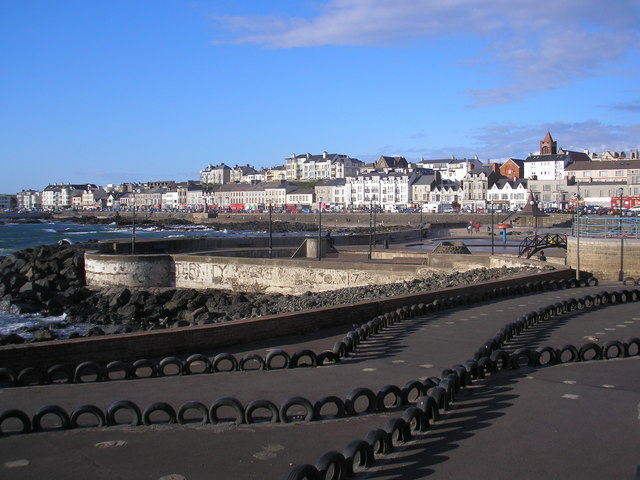
Portstewart, pictured below, is a seaside resort town in County Londonderry. The address at which Hugh White and his children were staying on the night of the 1911 census was 14 Victoria Terrace which was almost on the waterfront of Portstewart. I have deduced that there may be another reasonable explanation for why Hugh White was in Portstewart on the 1911 census night.
Portstewart, Londonderry

A search for the will of  Matilda's husband, John Campbell Junk, who died in 1893, showed me that John bequeathed to his wife and son Robert, his house and farms in Gortigal and his smaller farm in Ballyblagh, known as 'Paddy's Land.'  John ordered that yet another larger farm in Ballyblagh was to be sold to pay any off all debts. In the 1901 census Matilda, 58, Robert 19, and Minnie 17, were living on the farm at Gortigal. The address at which Hugh was staying along with Matilda Junk in 1911, 14 Victoria Terrace, Portstewart, overlooked the sandy two mile long beach known as the Strand. It is entirely possible, given his ill health, that perhaps my great grandfather was holidaying with his two young children at the seaside to recover. I am now able to begin to build a narrative of my family's life beyond their flax farm; a story founded on clues found in the Wills of ancestors.

CONSTRUCTING A  PICTURE OF THE BROADER FAMILY FROM WILLS

Wills can be an exclusive source of names on which to base further research regarding your family and social network within which they lived. The names you find in a Will can be as momentous as an obvious missing piece of a puzzle, or as obscure as a mysterious cue to point you in a certain direction. There can be something to discover about your own ancestors and the places they lived and visited, through researching their relationships with other people who were a part of their lives. The people mentioned in Wills as executors, for example would have most likely been a relative, a close friend or business partner or perhaps even a godparent to an ancestor's child. Seeking knowledge about the relatives, friends and other people within an ancestor's social and community network can enhance and enrich your understanding of your own forebears and their personal and social relationships.

When I discovered, through Samuel Clarke's Will,  that Matilda Junk, who my great grandfather, Hugh White was staying with at the time of the 1911 census, was the aunt of his wife, Sarah Jane (Thompson), I thought about the importance of names in Wills and their significance as fragments of evidence. I began investigating the people mentioned in my ancestors' Wills. Matilda's husband, John, in his own Will, named his brother, the Reverend Thomas W. Junk, of Six Mile Cross, as executor of his will. In reading the Will of the Reverend Thomas William Junk, I discovered the names of his children and that he was the Minister of the Presbyterian Church at Sixmilecross, Omagh, County Tyrone. Since the Junks were cousins of both my White and Clarke families, by extending my knowledge to the lives of these relatives, I am gradually constructing a picture of the wider family community beyond my great and great great grandparents. Since they all lived within a reasonably close distance of each other, it is reasonable to think that my family visited the places in which relatives lived, therefore, these places and people become an authentic and compelling part of our ancestors' life stories.

The Presbyterian Church at Sixmilecross, Omagh where the brother in law of my twi times great aunt, was the minister.
My husband also descends from a family with the surname of White in Northern Ireland as I do. Family anecdotes place his White ancestors in County Antrim although I have not found any sign of  them there. I have a niggling hunch that they might be secretly lying low in County Down, so I'm off to search the Will Calendars on the PRONI website to test my rationale......


Monday, March 17, 2014

St Patrick's Day Post

My Irish Ancestors

Image Wikimedia ©©

Saint Patrick's Day, March 17, is traditionally an Irish day of celebration for the Feast of St Patrick - La Fheile Padraig . Saint Patrick is the patron saint of Ireland. Although officially a  Catholic feast day, people all around the world, especially those of Irish descent, enjoy celebrating Irish heritage and culture. 

I have Irish ancestry, on both my mother's and my father's branches of my family tree, although until the 1990's I only knew of my Northern Irish Protestant connection. My paternal grandmother, Jemima Florence White who was born in 1902, in Brookend, County Tyrone was Orange through and through despite marrying a Catholic Scotsman. I had no idea of my Scottish Catholic background until researching my family history much later. My grandmother was a very important influence in my life so I grew up with a strong sense of my roots being firmly planted in Ireland. Being young and having no knowledge of the Ulster Plantation, I was unaware of just how 'planted'  those particular Irish roots were. If anyone asked me what nationality I was, whilst growing up, I always answered proudly - "Irish"!  In fact I have German/Swiss/Irish/ Scottish/English ancestry, but for the purpose of this St Patrick's Day Blog post, I am Irish!


Jemima Florence MacDade (nee White) Image S.White ©©

Jemima Florence White pictured above, may not have true Irish roots, however, to my surprise, I discovered  through my family history research that her husband Colin Hamilton McDade, born in Cumbernauld, Glasgow, Scotland in 1901 had very Irish catholic ancestry. I had found a marriage for Colin's parents John McDade and Elizabeth Gibson in 1894 in the Maryhill Catholic Church, but believing the family to be Presbyterian I filed this 'wrong' certificate away in a drawer. It was only when my aunt traveled to Scotland and visited the GRO in Edinburgh some years later, that we realised that this was indeed our own John McDade and that he was indeed catholic. Going back a further two generations, I discovered that my 4th great grandfather, James McDade was born in Ireland in around 1780. My McDades were Irish!

Elizabeth Gibson McDade  Image S.White ©©
This was not the only Irish branch of family I discovered hiding amongst the foliage of Scottish leaves on my tree. Elizabeth Gibson's mother, Mary Fearns ( surname also Farrins) although Scottish born, in Falkirk, Stirling in 1821, was the daughter of an Irish father, named George Farrins. Her mother, Mary Cupples born in Falkirk also was the fifth child of Alexander and Agnes Cupples of County Down in Northern Ireland.  My Irish family tree was sprouting branches rapidly.


Image Wikimedia ©©

Just as I thought I had unearthed all of my Irish forefathers, I came across a surprise Irish connection on my mother's family line. The discovery of my two times great grandfather, Michael Frayne, born in Dublin in 1820 has led me on an exciting Irish convict journey. A family of  Irish Frayne and Kelly convicts, in fact  who are the inspiration for my newest blog called Family Convictions - A Convict Ancestor. 

So on The feast day of Saint Patrick himself, 17th of March, 2014, I feel quite qualified to call myself Irish. At least in part. I wish a very happy St Patrick's Day to my all of friends of Irish descent.... and to my cousins descended from the Irish McDades and Leonards, and who all live now in Illinois, USA. 

'May good fortune be yours, may your joys never end' and may your river be as  green as the hills of Ireland. 


Sunday, March 2, 2014

Putting into Practice what I learned on the 4th Unlock The Past Cruise...

What did I learn on the 4th Unlock the Past Cruise?


It was probably just as well that internet connection on the ship Voyager of the Seas was non- existent in our suites, since at the end of each day I am certain every conference attendee would have been sitting at laptops, smart phones and tablets, late into the night, putting into practice the wealth of information taken away from the many and varied talks on board. In a series of blogs I hope to demonstrate how the knowledge I brought home from the cruise conference has been purposefully applied to my own research.

I have only just today, had an opportunity to take out my copious conference notes which filled three A4 notebooks.  Reading back through the information, I have had great difficulty in choosing a place to begin.  Jill Ball's talk on Evernote inspired me to get my family history in order; Kirsty Gray's talks on the  One Place Studies organisation (of which I am now a member) was of great interest to me as I already have two one place studies underway; Lieutenant Colonel Neil Smith's knowledgeable talks on Military research energised me to learn more about my own military ancestors; Chris Paton's entertaining talks which explained Scottish marriages and inheritance has galvanised my appetite for finding more about my Scottish ancestors; Kerry Farmer's fascinating talk on DNA for genealogists sent me home with a new determination to contact my most relevant DNA matches through FamilyTree DNA; Pauleen Cass's inceptive descant on FANS (friends and neighbours used as resources) has given me wonderful ideas for future research resources; Thomas MacEntee's brilliant information about technological applications for genealogy left me with a compulsion to add more social media and technology  tools to my ever growing list of genealogy playthings; Helen Smith's illuminating talk on Medical Health has made me more determined than ever to write up a 'cause of death' chart... There were so many more speakers whom I will mention in later posts and so many new things I learned from the many informative talks on board the Voyager of the Seas. As well, I was reminded of research resources I may have more previously found but inadvertently  overlooked. But where to begin.....

A talk underway in the conference centre

Whilst contemplating  my remarkable and overwhelming amount of cruise conference information, I opened up my Ancestry Tree on my laptop for inspiration. As I perused my forebears, all perched comfortably on the branches of my online tree, with some still hiding among the foliage of the past,  as is wont to happen, all thoughts and intentions of blogging flew out of the window as I became distracted by ancestral things. From there my journey took its own direction...

Prior to the 4th Unlock the Past Cruise in February of this year, I had added to my family tree, a three times great uncle named Joseph Turner who was born in Ipswich Suffolk, in 1820. I knew only the first names of his two wives from census records. Despite admirable intentions...a blog to write...Joseph's two wives coaxed me from my purpose, urging me to find them... and as is so often the case with family historians, I  forgot all else! Then suddenly, whilst absorbed in searching and not easily finding Joseph's marriages on Ancestry.com, Rosemary Kopittke's talk on The Genealogist  came to mind. I was reminded of Rosemary's comprehensive discussion regarding the benefits of this website, with aids such as first name only searches, a search by occupation or address facility, and extras such as links to click on which might show a map reference for an address, or explain an occupation one has never heard of.

Although I have had in the past, a subscription to The Genealogist, I have, in recent times tended to conduct my English research through sites such as FindMyPast, Ancestry, FamilySearch (a free search), and Origins.  I realised, during Rosemary's talk on the cruise, that I had overlooked some useful applications with regard to The Genealogist website. So, now, Joseph Turner's two wives offered me the perfect opportunity to put into practice and explore Rosemary's very enticing description of  how to access the most out of this website. I was also reminded of the benefits of searching far and wide rather than falling into the habit of relying on one or a few favourite genealogy sites such as Ancestry.com  for research.

*The successful outcome of this search, impressed upon me the advantages of The Genealogist as a family history research site and of the age old saying 'never put your eggs (or search for your ancestors) in one basket'! Of course, not everything is online and certificates need to be ordered to authenticate findings. With this in mind,  I set out to compare The Genealogist with sites I more commonly make use of.

Look for every possible source of information...

The first thing which I found interesting and a reminder to check multiple sources to verify information, was the confusing fact that Ancestry and The Genealogist had transcribed different parishes for Joseph's address in the 1851 census. The address I found on Ancestry was St Mary's of the Quay, Ipswich, Suffolk. The address provided in my search on The Genealogist, was Terrace Lane, St Mary's of the Elms. These are completely different parishes in Ipswich, Suffolk and obviously a transcription error on the part of one site. The Genealogist did have the added advantage of giving me the street name whereas on Ancestry.com I had to decipher this myself from the original census image and with the writing being almost illegible, this proved impossible. Adding insult to injury, I now had two different parishes as well as two different wives for Joseph!

Searching the address on FindmyPast  confused the issue even more as I found the address transcribed as Tunnel Lane, St Mary Key. A further search for Joseph Turner on the British Origins website also listed his address as Tunnel Lane St Mary Key. Familysearch listed the address as St Mary Key, St Clement, Ipswich. From my own examination of the original image despite the hard to decipher old handwriting, I could clearly read St Mary Key. According to Geograph  both the name Key and Quay have been commonly interchanged for this medieval church which is situated next to Ipswich's quayside. Google map searches to find old maps and street names close to both St mary's parishes, suggested to me that Joseph Turner in fact lived in neither Terrace nor Tunnel Lane but rather lived in Turret Lane, which is situated very close to the Church of St Mary's of the Quay, however that is a puzzle for another day.....It is Joseph's wives I am searching for!  Another reminder though, of the importance of searching in more than one place.

St Mary's of the Quay © Copyright Adrian S Pye and licensed for reuse under this Creative Commons Licence

From the 1851 UK census which I had accessed on Ancestry.com I knew that Joseph Turner's first wife was named Sarah. By the 1861 census his wife's name was Rosanner. In the 1871 census transcription on Ancestry, the second wife's name was shown as Rosina and in 1881, just to confuse matters even more, she appeared as Rosena. I set out to find out more about Joseph's first wife Sarah. By 1851, Joseph and Sarah Turner had two children - Sarah Turner born in 1849 and Eliza Munnings, born in 1845 and both according to the 1851 census, born in Ipswich, Suffolk. From Eliza's surname of Munnings I proposed that this may have been Sarah's maiden name. 

Joseph Turner on my Ancestry tree

I commenced my search on Ancestry for the marriage of Joseph Turner, his birth year, between the years 1844 and 1849  (covering  the childrens' birth years) in Suffolk. The eldest child, Eliza, having the surname of Munnings indicated that she was Sarah's daughter from before her marriage to Joseph, although she was stated to be Joseph's daughter on the census record. Finding no marriage to a Sarah,  I narrowed the search to the years between 1846 and 1849. Joseph Turner, it seems is a very common name in Suffolk. After scrolling though several pages of possible marriages, I finally found the only likely marriage, in the October to December quarter of 1847, in Ipswich, Suffolk, to a Sarah Manning.

When I searched The Genealogist website for a marriage for Joseph Turner using the same information, his name, date of birth,  and place Ipswich, Suffolk, between the years 1844 and 1849, I found a likely marriage immediately and rather than having to search several pages of results, it was the second entry on the first page of hits. This time the surname was transcribed as Munning.

A quick search found the marriage to Sarah Munning in 1848

Clicking on this result showed me that Joseph Turner married Sarah Munning in the October to December quarter of 1847. I discovered by an additional search on FamilySearch, that Joseph Turner and Sarah Munning were married on October 10, 1847 at St Matthew's, Ipswich, Suffolk. Saint Matthew, Ipswich, Suffolk was the same parish in which Joseph's parents were married which further suggested that I had found Joseph's first wife. This result recorded the surname as both Munning and Manning. Now feeling that I had a surname for Sarah I found the marriage on FindmyPast and more easily on Ancestry.com.  My search had been surprisingly easy using The Genealogist and I was impressed to say the least! The Genealogist also provided me with a link search for potential children of this marriage. Of course I will be ordering a copy of the marriage certificate to verify that this is my Joseph Turner, but my hunch tells me my Joseph's wife was Sarah Munning.

St Matthews Ipswich © Copyright Geoff Picks Creative Commons 

My search for Joseph's second wife was slightly more complicated, since Ancestry's transcriptions of census records gave her name as Rosanner in 1861, Rosina in 1871 and Rosena in 1881 and her death in 1883 gave her name as Rosina. Out of interest, I compared searches for the marriages on Ancestry and The Genealogist. On Ancestry I had two methods of searching. Firstly, I had the advantage of being able to search records for Joseph directly from my tree (by clicking 'search records' at the top of the page) or alternatively, I could to go into the UK records and then into the England and Wales FreeBDM marriage index to enter my information: Joseph Turner, born 1820, County Suffolk, and look for the second marriage between the years 1851 and 1861. On the first page of hits and the fifth entry down I found a marriage for Joseph Turner in Ipswich, Suffolk, April to June in 1855 to a Rosa Cleveland. 

Using The Genealogist website was slightly easier with a drop down menu to filter my search for marriages on the initial search page. So, no going into UK records, then finding marriage records before entering information. I found the same marriage (which was the only one with a female name anything like Rosina, Rosena or Rosanner) on the first page of results and as with Ancestry it was the fifth entry.

The marriage of Joseph Turner to Rosa Cleveland in 1855  using The Genealogist

Searching for Rosa Cleveland's birth and whereabouts on earlier census records on Ancestry, I discovered a Rossie Cleveland aged 8 years living in Ipswich, Suffolk in the 1841 census but with no parents present.  On examining the original census record I could clearly read that the name was Rosina and had been incorrectly transcribed. No birth or Christening record showed up. The same search on The Genealogist for Rosa Cleveland showed no result at all, however, after changing the name to Rosina, I found the 1841 census record which showed her sister Julia aged 3 years to be living with her. This hit also gave me the address of Chapel Yard in the parish of St Nicholas, with a clickable link, which I found to be a most useful added benefit on this site. I found Julia Cleveland in 1851 living in an Almshouse in Foundation Street, Ipswich, Suffolk, aged 14 years, her occupation a milliner, and living with her grandmother Mary Croft aged 72 years. Foundation Street is also in the parish of St mary's of the Quay, further supporting my earlier assumption.  Added research to me that Foundation Street is named for Tooley's and Smart's Almshouses. 'Henry Tooley, Portman of Ipswich by his will dated Nov 15 1550, left several estates for the purpose of erecting Alms houses ... for the main finance of poor persons therin.'  (Words from  a Plaque in Foundation Street.).  Sadly, it appears that Rosina and Julia Cleveland were orphaned at a young age. Before I become too attached to Rosa, I must apply for the marriage certificate which will verify that this is my own Joseph Turner, by the names of his parents.

There is much more to discover about Joseph Turner and his two wives, including their backgrounds, families and the children of both marriages. Rosemary Koppitke's talk on using The Genealogist as a source of UK records has pointed out to me some quite unique and worthwhile features for research on The Genealogist website and I will certainly not be overlooking it in my future UK research.

 I have also been reminded since the cruise, to organise my sources (thankyou to Jill Ball and Thomas MacEntee for their excellent suggestions with regard to doing this in their respective talks).  In this way, when I am researching, I will not overlook or forget about any resources that I have used in the past.

It is worthwhile searching more than one site to check for transcription errors

Thursday, February 13, 2014

The 4th Unlock the Past History/Genealogy Cruise - Part 1

What a Cruise!.. Part 1


Although I had harboured (metaphorically) grand designs to blog frequently from the cruise ship, Voyager of the Seas, and although I dutifully kept account of the daily activities and conference talks, my internet connection behaved so badly that I eventually gave up and simply enjoyed the cruise, the conference and the days spent in the ports we visited. Now, safely (but not entirely steadily) back on land, rather than present a precise day by day recount post cruise, I have decided to write an overview and my own thoughts regarding the nine days I spent on the 4th Unlock the Past History/Genealogy Cruise from February 4- February 13, 2014. The cruise took a large and enthusiastic group of genealogists and historians from Sydney to Melbourne, Adelaide and Hobart and I am certain I can speak for everyone, when I say that we returned with heads overflowing with new information, enthusiasm to put into practice new technological abilities, new friends, and for me particularly, an inability to stop rock and rolling! ( and I don't mean the partying kind). 

Image : wikipedia


Tuesday, February 4th, dawned grey and wet on the heels of perfect blue skies and sunshiny weather. Sydney failed to bedeck her spectacular harbour in fine weather on our day of departure but the rain did not dampen my enthusiasm to embark upon not only my first Unlock the Past Cruise, but my first EVER cruise! When I arrived at the Cruise Terminal at Circular Quay to board the Royal Carribean Line Ship, Voyager of The Seas, any thoughts of disappointment that I would  not be sailing out of the magnificent Sydney Harbour in glorious sunshine were quickly replaced by sheer awe as I gazed upon the magnitude and grandeur of this huge vessel. 


Voyager of the Seas at Circular Quay

Despite the wet weather, the view of the Sydney Harbour Bridge as the ship  pulled slowly way from the passenger terminal was exhilarating to say the least. Standing on deck 12 (of 15 decks ), I felt as though I was eye to eye with traffic on the bridge. I have been boating on the harbour many times, but it is certainly the first time I have been privileged  to appreciate such a magnificent view from a ship of this size.

Photo taken from deck 12 as we left


As we left behind the shores of Sydney Harbour and headed out to sea through The Heads, through quite rough and choppy water,  I struggled to gather my sea legs. Few people braved the windy, wet weather out on deck to watch us pass through The Heads.


Deck 11 was almost deserted in the rough weather


Inside the rocking (far more than I had expected) ship, I could not help but be reminded of my ancestors who voyaged in the past, to distant places, in ships no where near as glamorous or as comfortable as the one I was on board. Voyager of the Seas carries over 3,000 passengers and boasts entertainment which includes an ice rink, rock climbing wall, mini golf, basketball, a large casino as well as numerous bars, restaurants, swimming pools and a conference centre. With some time to spare before our 8 pm Meet and Greet in the Lounge known as Cleopatra's Needle, I acquainted myself  with the many luxurious decks of this ship, all the while wondering what the voyages of forebears had been like for them. 


The most recent ship on board which an ancestor of mine arrived in Australia, was the Largs Bay in 1923. Built in 1921, this passenger/ cargo steamship must have seemed very modern to my grandfather at the age of 19 years when he traveled from Scotland to Brisbane, Australia with his parents and seven of his eight siblings. 

Image wikipedia, creative commons

With some time to spare before our 8 pm 'Meet and Greet' in Cleopatra's Needle, one of the ship's numerous lounges,  I meandered through the ship  acquainting myself with the many decks and places to entertain or pamper oneself. There is no doubt that Voyager of the Seas is certainly much more luxurious than the passenger ship La Rochelle on which my courageous three times great grandmother sailed to Australia from Hamburg on, as a young unmarried woman of 22, in 1862. I wondered what my Christiana Siegler would have thought of a ship with such indulgent extravagances as a beauty spa for facials, manicures and hot stone massages, a large hair salon, movie theatre, state of the art comfortable staterooms, parades and non stop entertainment.....I have a new found admiration for the long voyages my ancestors made from Germany, Switzerland, Ireland, Scotland and England with none of the above mentioned hedonistic pleasures and often in the most confined and unsanitary conditions. 
I regress..... but after all, I am a genealogist and  I am reminded that but for the courage of ancestors I would not be enjoying the opulence of a ship such as Voyager of the Seas.

La Rochelle Image: StateLibQld. commons.wikipedia.org

One of the staircases on board Voyager of the Seas
The Promenade on deck 5
At 8 pm on the first night aboard, all members of our large (around 240 people) group met in Cleopatra's Needle for an initial get together. Many were, as was I, finding the rocking of the ship difficult to get used to, however, once we were all seated with a wine or cocktail or any fortifying drink, spirits ran high and the conference was undoubtedly off to an excellent start. Represented were were family historians and historians from all states of Australia, from New Zealand, the UK, Africa, and America. Group photographs were taken and these included, speakers, geneabloggers, members of Genealogists for Families (Kiva) among others.


Meet and Greet in Cleopatra's Needle

Meet and Greet
The meet and greet was an opportunity to catch up with friends, to be introduced to new like minded people and to finally put faces to names well known in the vast world of social media. I was pleased at last to meet in person, Thomas MacEntee from Chicago, USA. Thomas is well known in the genealogy world for his  Geneablogger fame and  I have chatted to him on Facebook and have long admired his enthusiastic and knowledgeable presence in the areas of genealogy, technology, social media and blogging. fellow bloggers and Twitter friends Jill Ball better known as Geniaus , Pauleen Cass, ( Cassmob, whose blog is Family History Across the Seas), Jackie van Bergen, Kerry Farmer, Shauna Hicks , Helen Smith were among people I always enjoy catching up with at genealogical events and I quickly realised that I was travelling in excellent company.  There were many cries of 'Oh that's YOU!' throughout the evening (and the entire voyage) as people who had only known each other by social media names, met for the first time in person. That is one of the great benefits of conferences, and where better to cement friendships, make new friends and share knowledge, than a nine day cruise along the eastern coastline of Australia, following literally in the 'wake' of many of our own ancestors' voyages. 

The first day ended in anticipation of an interesting conference to begin on Day 2, which boasted a wide range of topics and excellent speakers from all around Australia, in addition to overseas guest speakers including Chris Paton (Scotland), Jane Taubman (UK), Kirsty Gray (UK), Jan Gow (New Zealand) and Thomas MacEntee (USA). 
Conference centre on board Voyager of the Seas
Thankyou to everyone involved with Unlock the Past for organising  these genealogy/history cruises and for the enormous amount of planning which must go into such events.  I for one, am hooked!

Part 2 coming soon.....